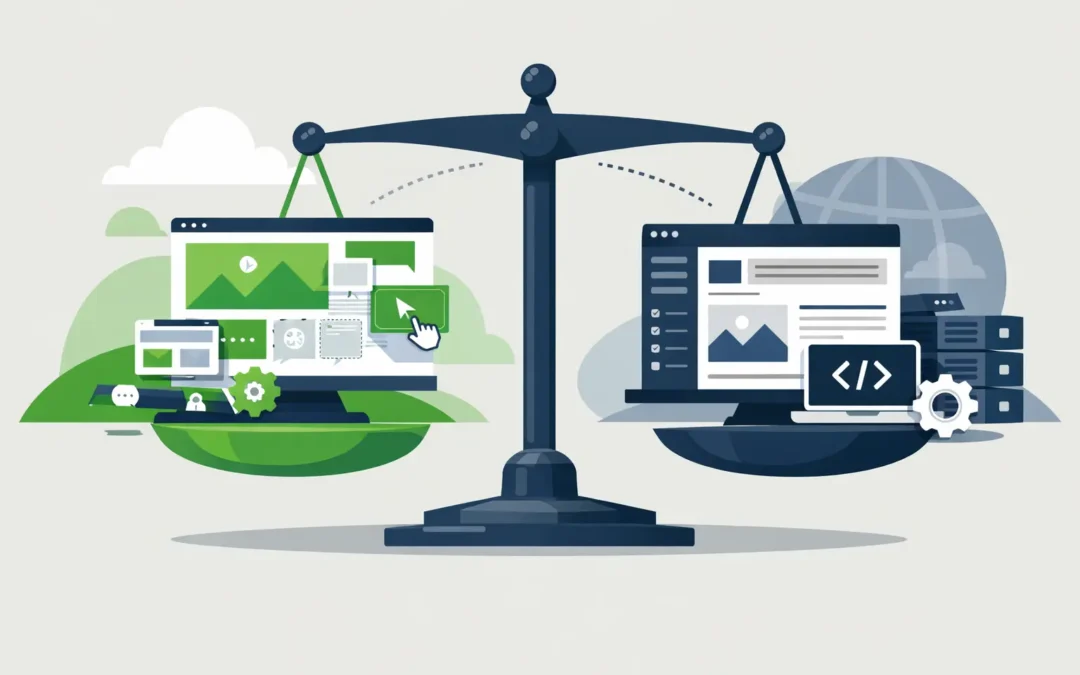
You can get a business site live this afternoon with a website builder. You can also spend that same afternoon comparing themes, plugins, and hosting options in WordPress. That is the real tension in the website builder vs WordPress decision: speed and simplicity on one side, flexibility and control on the other.
For small businesses, startups, bloggers, and agencies, the right choice depends less on hype and more on what you need the site to do six months from now. A basic brochure site, a lead generation site, a growing blog, and a high-traffic online store do not have the same technical needs. If you choose based only on what feels easiest today, you may hit limits later. If you choose based only on future potential, you may overcomplicate a simple project.
Website builder vs WordPress at a glance
A website builder is designed to reduce decisions. You usually get templates, drag-and-drop editing, bundled hosting, built-in updates, and a single dashboard. That makes it appealing for first-time site owners and busy teams that want a polished site without managing much infrastructure.
WordPress gives you a much wider range of control. You can choose your host, theme, plugins, performance setup, security tools, and development path. That freedom is why WordPress powers such a large share of the web, but it also means more responsibility. Even with managed WordPress hosting, there are still more moving parts than with a typical builder.
If your main goal is to launch quickly with minimal maintenance, a website builder often wins. If your main goal is long-term flexibility, custom features, and stronger ownership over your site environment, WordPress usually comes out ahead.
Where website builders make sense
Website builders are strongest when simplicity is the priority. A local service business that needs a homepage, service pages, contact forms, and a few updates each month may not need the full range of WordPress customization. The same is true for a new startup validating an idea or a solo professional who wants a clean online presence without hiring a developer.
The biggest advantage is convenience. Hosting, design tools, updates, and support are typically packaged together. You are not deciding which caching plugin to install or whether your theme conflicts with an add-on. That reduces setup time and lowers the chance of technical mistakes.
There is also a predictability factor. Builders often have straightforward monthly pricing, and the editing experience is usually easier for non-technical users. If multiple people on a small team need to edit content, that simplicity can save time.
The trade-off is that builders can become restrictive as your site grows. Template customization may be limited. Advanced SEO controls can vary. Integrations may depend on what the platform supports. If you want to add custom workflows, migrate to a different environment, or fine-tune performance, you may find yourself working around the platform instead of with it.
Where WordPress stands out
WordPress is a better fit when your website is a business asset rather than just a digital brochure. That includes content-heavy sites, eCommerce stores with specific feature needs, membership sites, booking systems, client portals, and marketing sites that need custom landing pages, analytics integrations, and room to scale.
Its strength is flexibility. You can start with a simple site and expand over time without rebuilding everything from scratch. Need advanced SEO tools, custom post types, multilingual support, or a specific payment workflow? There is a good chance WordPress can support it.
That flexibility also applies to infrastructure. You can run WordPress in shared hosting for a smaller project, move to managed WordPress hosting for easier maintenance, or scale to cloud, VPS, or dedicated environments as traffic and complexity increase. For businesses that expect growth, that matters.
The catch is that WordPress requires more active management. Core updates, plugin updates, backups, security hardening, and performance optimization all matter. A reliable hosting provider can simplify that work significantly, but WordPress still asks you to think more like an owner and less like a renter.
Cost is not as simple as it looks
A lot of buyers assume website builders are cheaper and WordPress is more expensive. Sometimes that is true, but not always.
With a website builder, the monthly subscription can look affordable at first because so much is bundled. Over time, though, costs can rise if you need better templates, eCommerce features, marketing tools, or additional seats. The bigger issue is not always the sticker price. It is whether you are paying for convenience at the expense of flexibility.
WordPress can be very cost-effective, especially for businesses that want control over hosting and plugins. But costs vary because you are assembling the stack. Hosting, premium themes, paid plugins, security tools, backups, and developer help can all affect the total.
This is where context matters. A simple WordPress site on dependable hosting may cost less than a premium builder plan. A custom WordPress setup with advanced functionality may cost more, but it may also deliver more business value. The best question is not “Which is cheaper?” but “Which gives me the right level of performance, control, and support for the budget I have?”
SEO, speed, and performance
For businesses that rely on search traffic, the website builder vs WordPress comparison gets more practical. Both can perform well, but they do not offer the same level of control.
Many website builders cover the basics. You can usually edit page titles, meta descriptions, image alt text, and URLs. For smaller sites, that may be enough. But if you want deeper technical SEO options, more control over site structure, schema, redirects, and performance tuning, builders can feel limiting.
WordPress usually gives you more room to optimize. You can control technical SEO in greater detail, choose lightweight themes, fine-tune caching, compress assets, and adjust your hosting environment for better speed. That does not mean every WordPress site is fast. Poor hosting and too many plugins can slow it down quickly. But the ceiling is higher when the site is configured well.
Performance is not just a platform issue. It is also a hosting issue. Fast SSD-based infrastructure, free SSL, reliable uptime, and strong support can make a noticeable difference in how a WordPress site performs under real traffic.
Security and maintenance
Website builders are often appealing because maintenance happens behind the scenes. The platform handles updates and much of the security stack. For non-technical users, that is a legitimate advantage.
WordPress can also be secure, but it benefits from a more active approach. Core software must stay updated. Plugins and themes should be vetted and maintained. Backups should be routine, not occasional. Security tools and malware protection are worth considering, especially for business sites that collect leads, process payments, or manage customer data.
This does not make WordPress risky by default. It means your setup matters. Managed WordPress hosting, automatic updates, regular backups, and support from a provider that understands WordPress can close much of the maintenance gap while preserving the platform’s flexibility.
Which option is better for eCommerce?
If you are launching a small store with a limited catalog and standard checkout flow, a website builder may be enough. It can get products online fast, and for some merchants, speed to launch matters more than advanced customization.
If your store needs more than the basics, WordPress often becomes the stronger option. Complex shipping rules, custom product pages, subscriptions, content marketing, and integration with third-party tools are easier to support in a more flexible environment. Store owners also tend to care deeply about page speed, checkout experience, and ownership of the platform as revenue grows.
For eCommerce, growth usually exposes platform limitations quickly. A builder can work well at the beginning, but WordPress offers more headroom if your catalog, traffic, or operational needs expand.
How to choose without overthinking it
If you want the simplest path to a professional site and do not expect major customization, a website builder is a practical choice. It keeps the process focused and manageable.
If you want room to grow, stronger control over SEO and performance, access to more integrations, and the ability to scale your hosting environment as the business grows, WordPress is usually the safer long-term investment.
For agencies and developers, the answer often leans even more strongly toward WordPress because it supports repeatable workflows, deeper customization, and a broader range of client needs. For beginners, the right answer may come down to whether you want a tool that abstracts the technical work or a platform that gives you more ownership.
At Charter Hosting, this is where the hosting conversation matters. WordPress becomes much easier to manage when the underlying environment is fast, secure, and backed by support that can help with migrations, setup, and growth planning.
The best platform is the one that fits the stage your business is in now without boxing you in later. If your website only needs to exist, a builder may be enough. If your website needs to perform, adapt, and scale with the business, WordPress is usually worth the extra control.